
Artificial Intelligence (AI) is transforming the way individuals and businesses work. From writing content and creating images to automating workflows and analyzing data, AI has become an essential part of modern life. Whether you are a student, entrepreneur, marketer, freelancer, or business owner, understanding AI can help you increase productivity, reduce costs, and stay ahead of the competition.
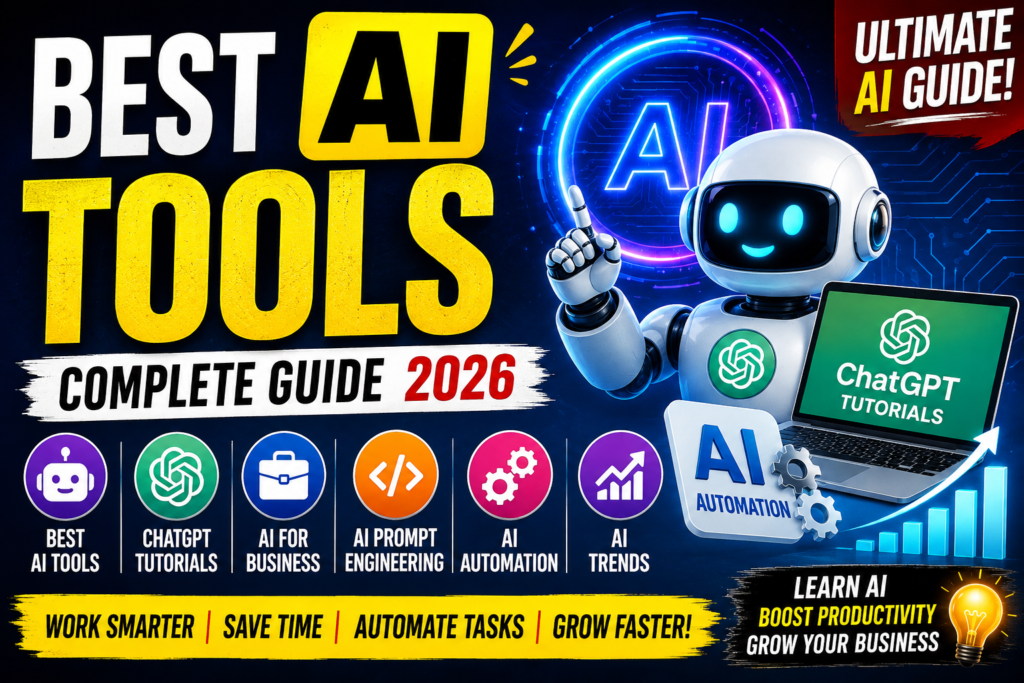
In this comprehensive guide, we’ll explore the best AI tools, learn ChatGPT, understand AI prompt engineering, discover AI automation strategies, and explore the latest AI trends shaping the future.
Best AI Tools in 2026
The AI ecosystem is growing rapidly, with thousands of tools available for different tasks. Here are some of the most popular categories.
1. AI Writing Tools
These tools help create blogs, emails, advertisements, reports, and social media content.
Popular features include:
- Blog writing
- SEO optimization
- Product descriptions
- Email generation
- Script writing
- Content summarization
Benefits:
- Saves hours of writing time
- Improves grammar
- Generates creative ideas
- Supports multiple languages
2. AI Image Generation Tools
AI image generators can create realistic photos, illustrations, logos, posters, and marketing creatives from text prompts.
Common use cases:
- YouTube thumbnails
- Social media posts
- Advertising creatives
- Product mockups
- Book covers
- Website graphics
3. AI Video Creation Tools
Video AI tools can generate complete videos using text, images, voiceovers, and avatars.
Popular applications include:
- Marketing videos
- Educational videos
- YouTube automation
- Product demos
- Explainer animations
- Corporate presentations
4. AI Coding Assistants
Developers use AI to:
- Write code
- Debug programs
- Generate documentation
- Build websites
- Create APIs
- Learn programming faster
5. AI Productivity Tools
These tools improve workplace efficiency by helping with:
- Meeting summaries
- Note-taking
- Project management
- Email organization
- Task automation
- Calendar scheduling
ChatGPT Tutorials: Learn AI the Smart Way
ChatGPT has become one of the world’s most popular AI assistants. It helps users perform everyday tasks quickly and efficiently.
What Can ChatGPT Do?
ChatGPT can help you:
- Write blog articles
- Create social media posts
- Draft emails
- Generate business plans
- Translate languages
- Write resumes
- Prepare interview questions
- Create presentations
- Explain complex concepts
- Generate code
- Analyze documents
- Brainstorm business ideas
Beginner ChatGPT Tutorial
Step 1
Create a ChatGPT account.
Step 2
Start with simple prompts.
Example:
Write a blog about digital marketing.
Step 3
Be specific.
Instead of:
“Write a blog.”
Try:
“Write a 2000-word SEO-friendly blog on digital marketing with headings and FAQs.”
The more details you provide, the better the output.
Advanced ChatGPT Techniques
Experienced users often ask ChatGPT to:
- Act as a marketing expert
- Think like a business consultant
- Create content in a specific tone
- Optimize for SEO
- Generate multiple versions
- Follow a structured format
This approach significantly improves the quality of responses.
AI for Business
Businesses of every size are adopting AI to improve operations and customer experiences.
Marketing
AI can:
- Generate advertisements
- Create social media posts
- Write blogs
- Design campaigns
- Produce marketing strategies
Customer Support
Businesses use AI chatbots to:
- Answer customer queries
- Handle FAQs
- Provide 24/7 support
- Reduce support costs
Sales
AI helps sales teams by:
- Finding leads
- Writing sales emails
- Predicting customer behavior
- Managing CRM systems
- Creating personalized offers
HR & Recruitment
AI assists HR professionals with:
- Resume screening
- Interview scheduling
- Candidate matching
- Employee onboarding
- Performance analysis
Finance
AI improves financial operations through:
- Expense tracking
- Invoice processing
- Fraud detection
- Financial forecasting
- Budget planning
AI Prompt Engineering
Prompt engineering is the skill of communicating effectively with AI.
A prompt is simply an instruction given to an AI model.
Better prompts produce better results.
Characteristics of Good Prompts
A high-quality prompt should include:
- Objective
- Context
- Target audience
- Tone
- Output format
- Word count
- Examples
- Constraints
Example Prompt
Weak Prompt
Write a blog.
Strong Prompt
Write a 2,500-word SEO-optimized blog about digital marketing trends in 2026. Include H2 and H3 headings, FAQs, keyword optimization, examples, and a conclusion. Write in a professional yet beginner-friendly tone.
The second prompt gives the AI enough context to generate a far more useful result.
Prompt Engineering Tips
- Be specific.
- Give clear instructions.
- Define the audience.
- Mention the desired format.
- Include examples where appropriate.
- Iterate and refine prompts based on the output.
Prompt engineering has become one of the most valuable AI skills for professionals in marketing, education, software development, and business.
AI Automation
AI automation combines artificial intelligence with workflow automation to eliminate repetitive tasks.
Businesses use AI automation to increase efficiency and reduce manual work.
Examples of AI Automation
Marketing
- Social media scheduling
- Email campaigns
- Lead generation
- Content publishing
Customer Service
- AI chatbots
- Ticket routing
- Automated replies
- Customer follow-ups
HR
- Resume screening
- Employee onboarding
- Attendance tracking
- Payroll support
Finance
- Invoice generation
- Expense categorization
- Reporting
- Financial analysis
E-commerce
- Product recommendations
- Inventory management
- Order tracking
- Customer support
Benefits of AI Automation
- Faster operations
- Lower operational costs
- Higher productivity
- Fewer manual errors
- Improved customer satisfaction
- Better decision-making through data analysis
Latest AI Trends in 2026
AI continues to evolve rapidly. Here are some of the most significant trends.
1. AI Agents
Autonomous AI agents can plan tasks, make decisions, and execute complex workflows with minimal human intervention.
2. Multimodal AI
Modern AI systems can understand and generate text, images, audio, and video simultaneously, enabling richer interactions.
3. Personalized AI Assistants
Businesses and individuals are increasingly using AI assistants tailored to their specific workflows, industries, and preferences.
4. AI Search
Traditional keyword search is being complemented by conversational AI experiences that provide direct answers and insights.
5. AI-Powered Education
AI tutors, personalized learning paths, automated assessments, and virtual classrooms are reshaping education.
6. AI in Healthcare
Healthcare providers use AI for diagnostics, medical imaging, patient monitoring, drug discovery, and administrative support.
7. AI Cybersecurity
AI helps organizations detect cyber threats, identify anomalies, prevent fraud, and respond to attacks more quickly.
8. AI Content Creation
Businesses increasingly use AI to generate:
- Blog posts
- Videos
- Podcasts
- Marketing copy
- Presentations
- Product descriptions
- Social media campaigns
Why Learning AI Is Essential
AI is no longer optional—it is becoming a core skill across industries. Professionals who understand AI tools, prompt engineering, automation, and business applications are better positioned to improve productivity, innovate, and remain competitive.
Whether you’re a student, freelancer, marketer, entrepreneur, or corporate professional, investing time in AI learning today can unlock new career opportunities and help future-proof your skills.
Frequently Asked Questions (FAQs)
Which AI tool is best for beginners?
A conversational AI assistant is an excellent starting point because it can help with writing, learning, brainstorming, coding, and productivity tasks through natural language.
What is AI Prompt Engineering?
Prompt engineering is the process of crafting clear and structured instructions that help AI generate accurate, relevant, and high-quality outputs.
How can businesses benefit from AI?
Businesses can use AI for marketing, customer support, sales, automation, analytics, HR, finance, and decision-making, improving efficiency while reducing costs.
Is AI replacing human jobs?
AI is changing how work is performed by automating repetitive tasks. It also creates new opportunities in AI development, prompt engineering, automation, strategy, and human-AI collaboration.
What should I learn first in AI?
Start with the fundamentals of AI, learn how to write effective prompts, explore conversational AI tools, understand automation workflows, and then move into advanced applications such as AI agents and business integration.
Conclusion
Artificial Intelligence is reshaping every industry, offering unprecedented opportunities to innovate and work more efficiently. By mastering AI tools, learning how to communicate effectively through prompt engineering, implementing automation, and staying informed about emerging trends, individuals and businesses can unlock significant competitive advantages. The future belongs to those who embrace AI as a partner in creativity, productivity, and decision-making.